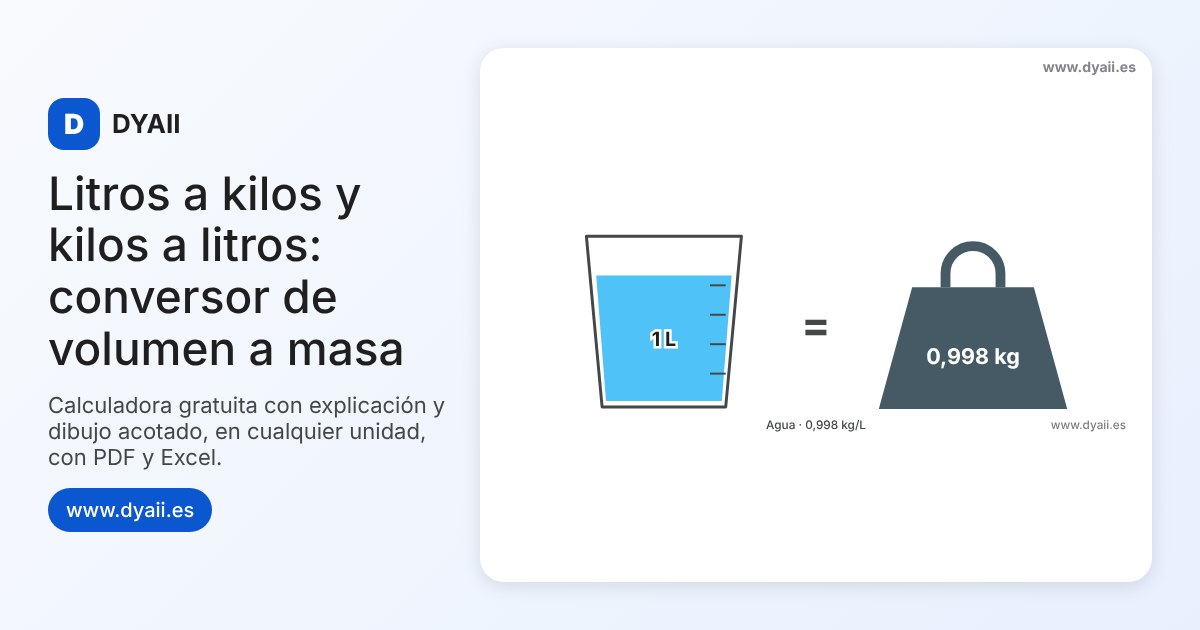
Liters to kilograms and kilograms to liters: volume to mass converter
Convert liters to kilograms and kilograms to liters for water, oil, diesel, gasoline, milk, honey and other products, or with the density you enter.
How many kilograms are 20 liters of diesel? How many liters does a kilogram of honey take up? To convert volume to mass, and back, you need the density of the product. Choose the product or type its density and convert both ways.
How to use the converter
- Choose the product: the density is filled in automatically. If yours is not listed, choose “Other” and type its density.
- Type the liters to get the kilograms, or type the kilograms to get the liters.
- You can change the units: milliliters, cubic meters, gallons, grams, tonnes, pounds…
Formula to convert liters to kilograms
With the density in kg/L, which is the same as g/cm³ or t/m³. If you have it in kg/m³, divide it by 1000: water has about 1000 kg/m³, that is, 1 kg/L.
How much does a liter weigh?
Approximate densities at about 20 °C (68 °F):
| Product | Density (kg/L) | 1 liter weighs | 1 kilo takes up |
|---|---|---|---|
| Water | 0.998 | 0.998 kg | 1.002 L |
| Milk | 1.03 | 1.03 kg | 0.9709 L |
| Olive oil | 0.912 | 0.912 kg | 1.096 L |
| Sunflower oil | 0.92 | 0.92 kg | 1.087 L |
| Cream | 0.99 | 0.99 kg | 1.01 L |
| Melted butter | 0.911 | 0.911 kg | 1.098 L |
| Honey | 1.42 | 1.42 kg | 0.7042 L |
| Maple syrup | 1.33 | 1.33 kg | 0.7519 L |
| Soy sauce | 1.15 | 1.15 kg | 0.8696 L |
| Orange juice | 1.04 | 1.04 kg | 0.9615 L |
| Wine | 0.99 | 0.99 kg | 1.01 L |
| Beer | 1.01 | 1.01 kg | 0.9901 L |
| Vinegar | 1.01 | 1.01 kg | 0.9901 L |
| Flour (bulk) | 0.59 | 0.59 kg | 1.695 L |
| Sugar (bulk) | 0.85 | 0.85 kg | 1.176 L |
| Powdered sugar | 0.56 | 0.56 kg | 1.786 L |
| Rice (bulk) | 0.8 | 0.8 kg | 1.25 L |
| Table salt | 1.2 | 1.2 kg | 0.8333 L |
| Cocoa powder | 0.42 | 0.42 kg | 2.381 L |
| Rolled oats | 0.41 | 0.41 kg | 2.439 L |
| Seawater | 1.025 | 1.025 kg | 0.9756 L |
| Hydraulic oil | 0.87 | 0.87 kg | 1.149 L |
| Diesel fuel | 0.835 | 0.835 kg | 1.198 L |
| Gasoline (petrol) | 0.745 | 0.745 kg | 1.342 L |
| Kerosene | 0.8 | 0.8 kg | 1.25 L |
| Ethyl alcohol | 0.789 | 0.789 kg | 1.267 L |
| Ethylene glycol | 1.113 | 1.113 kg | 0.8985 L |
| Mercury | 13.534 | 13.53 kg | 0.07389 L |
| Dry sand | 1.6 | 1.6 kg | 0.625 L |
| Cement (bulk) | 1.44 | 1.44 kg | 0.6944 L |
Worked examples
- 20 L of diesel: 20 × 0.835 = 16.7 kg.
- 5 kg of honey: 5 ÷ 1.42 ≈ 3.52 L.
- 1000 L of water: 1000 × 0.998 = 998 kg.
- 1 kg of olive oil: 1 ÷ 0.912 ≈ 1.1 L.
Temperature changes the density
Liquids expand when heated, so their density drops as the temperature rises. For diesel or gasoline the difference between winter and summer can reach 1-2 %, which is why fuels are measured at 15 °C in wholesale trade.
Frequently asked questions
Does a liter of water weigh one kilogram?
Almost: at 4 °C it weighs practically 1 kg and at 20 °C about 998 g. For everyday purposes, 1 liter of water is 1 kilogram.
How many kilograms are 1000 liters of diesel?
About 835 kg, with a density of 0.835 kg/L. Depending on the temperature and the type of diesel it can vary between 820 and 845 kg.
How many liters is one kilogram of oil?
About 1.1 liters. Olive oil has a density of about 0.91 kg/L, lower than water, which is why it floats.